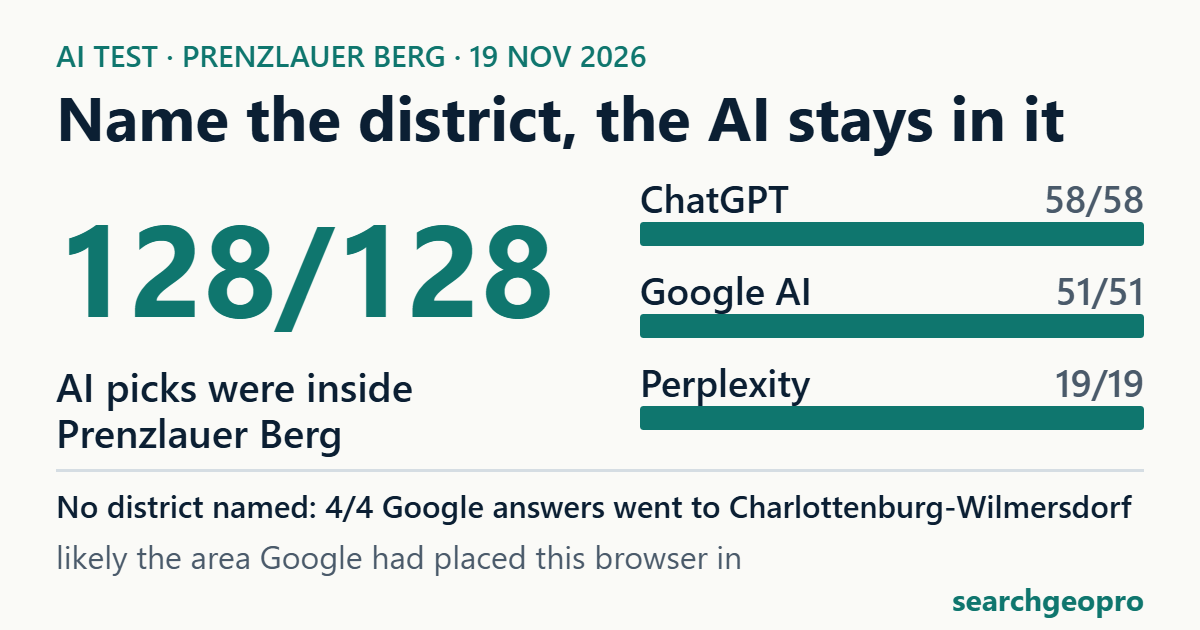
Most Berlin businesses with one location do not need a separate page for every district. They need one clear page that says where they are: the district, the Kiez and the street, in the homepage title, on the contact page and on the Google Business Profile. A separate district page makes sense for a real second location. On 19 November 2026 I asked ChatGPT, Perplexity and Google 16 questions about beauty salons in Prenzlauer Berg. When a question named the district, all 128 picks in the AI answers were inside it. Many of the studios that ranked for those searches had a homepage that already said “Prenzlauer Berg”.
This post explains what the test showed about district searches in Berlin, what Google’s own rules say about pages made for places, and a simple plan for which pages to build. I name no salon. The point is how the tools choose, not who does the best facial.
How did I run the test?
I used the same 8 fixed customer questions I use for every niche test, once in English and once in German, in ChatGPT, Perplexity and Google. The browser was signed out of every service. That makes 48 searches, run on 19 November 2026 between about 12:25 and 12:55 Berlin time. Six of the eight questions name the district. Two ask about Berlin as a whole, which turned out to matter.
| # | English | German |
|---|---|---|
| 1 | best beauty salon in Prenzlauer Berg | bester Kosmetiksalon in Prenzlauer Berg |
| 2 | English-speaking beauty salon in Prenzlauer Berg, Berlin | englischsprachiger Kosmetiksalon in Berlin Prenzlauer Berg |
| 3 | … a beauty salon near Prenzlauer Berg that takes new clients? | … der neue Kunden annimmt? |
| 4 | beauty salon Prenzlauer Berg open on Saturday | Kosmetiksalon Prenzlauer Berg samstags geöffnet |
| 5 | Which beauty salon in Berlin has the best reviews? | Welcher Kosmetiksalon in Berlin hat die besten Bewertungen? |
| 6 | beauty salon in Prenzlauer Berg for expats | Kosmetiksalon in Prenzlauer Berg für Expats |
| 7 | How do I choose a good beauty salon in Berlin? | Wie finde ich einen guten Kosmetiksalon in Berlin? |
| 8 | beauty salon near me Prenzlauer Berg Berlin | Kosmetiksalon in meiner Nähe Prenzlauer Berg Berlin |
ChatGPT answered all 16. Google showed an AI Overview on 14 of its 16 result pages; on both “near me” searches it did not load. Perplexity answered only 6 of 16 and showed a sign-up wall on the other 10, so I treat its answers as examples, not patterns. That leaves 36 AI answers on 38 answer pages.
Name the district, and the AI answer stays in it
On the questions that name Prenzlauer Berg, I counted every pick in the AI text: 58 in ChatGPT, 51 in Google’s AI Overviews and 19 in Perplexity’s answers. Many salons were picked more than once, so these are recommendations, not separate businesses. All 128 were in Prenzlauer Berg, by postcode or by the engine’s own label. None of the AI answers padded the list with salons from the next district.
The one exception sat outside the text. On two German answers, Perplexity’s own map panel showed businesses from neighbouring areas (one from Weißensee, a pack from Mitte and Wedding), while its written answer stayed inside the district.
The lesson for a business owner is simple. When a customer types your district, the tools look for businesses that are clearly in it. If nothing on your website, profile or listings connects you to that district, you are easy to leave out.
Leave the district out, and the answer follows the searcher
Questions 5 and 7 ask about Berlin as a whole. On all 4 of those Google pages, every business the AI Overview named was in Charlottenburg-Wilmersdorf. One English answer said so directly: top-rated salons in Berlin, “especially in Charlottenburg-Wilmersdorf”. None was in Prenzlauer Berg. That looks like distance at work, not a favourite district: in my last two tests, Google placed this same signed-out browser mostly in Charlottenburg-Wilmersdorf, and in the Neukölln test a week earlier the Berlin-wide review answer went mostly there too. When the question names no district, Google fills the gap with where it thinks you are.
ChatGPT did it differently. For the Berlin-wide questions it labelled each pick with its district (Mitte, Charlottenburg, Zehlendorf and so on), so the reader could choose by area.
Either way, a citywide question mostly goes to businesses near the person asking. A business in Prenzlauer Berg wins the searches that name Prenzlauer Berg, or a part of it, and the searches made nearby. That is a reason to make the district obvious, not a reason to pretend you are in every district.
The tools ask “which Kiez?”
8 of the 36 AI answers asked the customer where they wanted to go. ChatGPT’s German how-to answer opened its follow-up form with “In welchem Berliner Bezirk suchst du?”. Its German “near me” answer went further and offered Kollwitzkiez, Helmholtzkiez and “near Schönhauser Allee” as choices. Google’s English how-to AI Overview told readers to “pick a Kiez (neighborhood) that fits your commute”. One German AI Overview had a table column called “Kiez / Lage”, and Perplexity described salons as near Kollwitzplatz or Helmholtzplatz.
So the AI tools think below district level. They place businesses by Kiez, square, street and U-Bahn station. Those details come from addresses and from the words on your pages. If your site says “Prenzlauer Allee, near Kollwitzplatz, five minutes from U Senefelderplatz”, the tools have something to repeat. That sentence costs nothing and needs no extra page.
Which pages ranked for the district searches?
I looked at the ordinary Google results under the AI Overviews for the district questions. Three kinds of page kept appearing.
- Homepages that say where they are. At least 9 businesses had “Prenzlauer Berg” in their homepage title or first line, for example “Kosmetikstudio Berlin Prenzlauer Berg”. One of them also put its Saturday hours in the text Google showed.
- Booking platforms’ district lists. One platform’s “Top 20 Kosmetikstudios in Prenzlauer Berg” page ranked on at least 7 of the 16 Google pages, and that platform appeared on at least 26 of the 38 answer pages. Every source label shown in Perplexity’s four German answers was that platform. A second platform’s district pages ranked too.
- A few real district pages. A chain with three Berlin locations had a page for its Prenzlauer Berg branch, and that page ranked. A massage and facial studio had a page at /prenzlauer-berg with a line saying which languages its team speaks, and Google’s AI Overview used that site as the source when it named the studio as English-speaking.
One more page is worth a closer look. A studio in Friedrichshain has a page aimed at Prenzlauer Berg customers, honestly worded (“15 minutes by U2 or tram”). It ranked on page one for two German searches. It was named in none of the AI answers, which all stayed inside the district.
What Google says about one page per place
Google’s spam policies describe doorway abuse as pages “created to rank for specific, similar search queries”. One of their examples is a set of pages aimed at different regions or cities that all funnel visitors to one page. A dozen near-identical “beauty salon Mitte”, “beauty salon Kreuzberg” pages for one studio in Prenzlauer Berg can fall under that description.
The same caution applies to your Google Business Profile. At least 13 business names shown in my test, in map pins, ads and booking-platform listings, had a district or street attached, such as “… – Prenzlauer Berg” or “… Kosmetikstudio Prenzlauer Berg”, and the AI answers copied such names. Some may be the real names on the shop sign; I did not check. Google’s profile guidelines say your name “should reflect your business’s real-world name”, and that including unnecessary information in it “isn’t permitted, and could result in the suspension of your Business Profile”. If the district is not part of your real name, put it in your address, description and website instead.
Google’s local ranking page explains why distance matters anyway: local results combine relevance, distance (“how far each business is from the customer who’s searching”) and prominence. A page cannot move your shop closer to Kreuzberg.
So which district pages should you build?
Use this order. Most businesses stop after the second step.
- One location: make the homepage local. Put the district in the title (“Kosmetikstudio in Berlin Prenzlauer Berg”), and the Kiez, street and nearest station in the first lines and on the contact page. Write your Saturday hours, languages and booking options as plain sentences. Match them on your Google Business Profile.
- Be on the district lists you don’t own. Booking platforms and city guides rank for “[service] [district]” searches, and AI tools read them. Keep your platform profile’s hours, languages and ratings in line with Google. In my test two salons had different Saturday hours on the platform and on Google, and a studio that ChatGPT called “English confirmed” was “not confirmed” in Perplexity, which read the platform page.
- A second real location: give it its own page. Own address, hours, team, photos and directions. That is a location page, not a doorway.
- Customers from next door: one honest “nearby” page at most. Say where you are and how long it takes to get there. In my test, one such page ranked in Google’s results but was not named in any AI answer for that district.
- Skip pages for districts you only want. If the page would read the same with the district name swapped, don’t publish it.
What made a salon the AI’s pick inside the district?
Being in the district got a salon into the pool. Being named needed proof the tools could quote. Three things stood out, the same patterns I saw with hairdressers in Neukölln and physios in Mitte:
- New clients. All 3 picks in ChatGPT’s German answer had a named new-client treatment or a “for new clients” page, two with a price. Google named first-visit services with their length and price. Perplexity found no such proof and told the reader to call.
- Languages. The tools separated “the salon says so” from “customers mention it in reviews”, and an English version of a website counted as proof.
- Consistent facts. Ratings, hours and addresses for the same salon differed between sources (for one salon, 4.8 stars in ChatGPT’s text and 4.2 on its own map pin). Each tool repeated whichever source it read.
FAQ
Do I need a page for each Berlin district?
Not if you have one location. One local homepage, a clear contact page and a complete Google Business Profile cover your own district. Build a page per district only for real locations.
Should my page name the Kiez or the district?
Both. The district (Prenzlauer Berg) is what most people type. The Kiez, square or street (Kollwitzkiez, Helmholtzplatz, Schönhauser Allee) is what the AI tools used to place businesses more precisely.
Can I add my district to my Google Business Profile name?
Only if it is part of your real-world name, used on your sign and website. Otherwise Google treats it as unnecessary information, which its guidelines say can lead to suspension.
I serve customers all over Berlin. What then?
Name your base district honestly, list the areas you serve in your profile’s service area if you travel to customers, and earn mentions on district lists and guides. Google’s answers to citywide questions in my test followed where it placed the searcher, so being listed on the guides and platforms those answers come from matters more than extra pages.
Want me to check your district visibility?
I can run these questions for your niche and district, check which pages and listings the answers rely on, and tell you which page to fix first. Send me your website through the local SEO Berlin page. I work in English. For the profile itself, start with my Google Business Profile checklist for Berlin.
Test notes: one run, one lunchtime, one browser, signed out; the engines set the location themselves, and answers change from run to run. Perplexity answered 6 of 16 questions. Ratings are snapshots. Nothing here measures the quality of any salon’s work.